On this page
There are different treatments available for diffuse large B-cell lymphoma and they can differ depending on your specific subtype.
The best treatment for you will depend on many factors including your:
- subtype of DLBCL
- stage and grade of your DLBCL
- age
- overall health
- other treatments you have, either for your DLBCL or other illnesses
- your own preference once your doctor has explained the options to you.
If you’ve had treatment for your lymphoma in the past, your doctor will consider how well it worked for you, and how bad any side-effects were for you. Your doctor will then be able to offer the best treatment options for you. If you’re not sure why the doctor has made the decisions they’ve made, please make sure to ask them to explain it to you – they are there to help you.
What are DLBCL treatment cycles?
Treatment for DLBCL is given in cycles. This means, instead of getting all the treatment at once, you will have some treatment, then a break (usually 2 or 3 weeks) and then more treatment.
Treatment is given like this to keep you safe. If we gave you all the chemo in one go, to destroy all the lymphoma – it would be very dangerous for you because chemo also attacks healthy cells.
So, it is given in cycles so that it can destroy a lot of the lymphoma, and then you have a few weeks for your healthy cells to recover or replace themselves. The number of cycles you have will depend on what treatment you have, and how well you respond to it.
Healthy cells are much better at recovering than the lymphoma cells, so each time you have treatment you will have less and less lymphoma in your body.
What are lines of treatment?
Sometimes lymphoma doesn’t respond to the first type of treatment you have. When this happens, the lymphoma may stay the same, or get worse even with the treatment. When this happens, the lymphoma is called refractory.
In some cases, DLBCL responds very well to treatment, and you may go into remission. This means that there are no signs of lymphoma left in your body. However, after some time – it could be months or even a few years later it may come back. When this happens it is called a relapse.
The first time you have a treatment for DLBCL it is called first-line treatment. First line treatment usually involves around 6 cycles of treatment. But the final number of cycles will depend on the treatment protocol and how well you respond.
If your lymphoma is refractory or relapses, the next time you have treatment it is called second-line treatment. Many people can still be cured or achieve long-term remission after second-line treatment. If it happens again, it is called third-line treatment.
Many people will actually be cured after first-line treatment. But some may need second, third line treatment or more.
Useful definitions
- Refractory: This means the lymphoma does not get better with treatment. The treatment didn’t work as hoped.
- Relapsed: This means the lymphoma came back after being gone for a while after treatment.
- 2nd line treatment: This is the second treatment you get if the first one didn’t work (refractory) or if the lymphoma comes back (relapse).
- 3rd line treatment: This is the third treatment you get if the second one didn’t work or the lymphoma comes back again.
- Approved: Available in Australia and listed by the Therapeutics Goods Administration (TGA).
- Funded: Costs are covered for Australian citizens. This means if you have a Medicare card, you shouldn’t have to pay for the treatment.
What types of treatment are used for DLBCL?
Some of the different types of treatments you may be offered are listed below. Select a heading to learn more.
Chemotherapy
Chemo is the most common treatment for DLBCL, and is often given along with a monoclonal antibody – a type of immunotherapy. When you do have both types of treatments together it is called chemoimmunotherapy.
Chemo kills fast growing cells which makes it very effective at fighting DLBCL. But, it can also affect some of your good cells that grow fast causing side effects.
Immunotherapy
Immunotherapy is a broad term to describe medicines that help your own immune system find, and fight the lymphoma more effectively.
Types of immunotherapy that may be used to fight DLBCL include:
- Monoclonal antibodies
- Bispecific Antibodies
- Conjugated Antibodies
When immunotherapy is given with chemotherapy, it is called chemoimmunotherapy.
Chemo-immunotherapy
Treatment protocol that includes chemotherapy and immunotherapy. For example:
R-CHOP includes the MAB rituximab (immunotherapy) which is given along with 3 chemotherapy medicines.
Monoclonal antibody (MAB)
You may have a MAB infusion at a cancer clinic or hospital. MABs attach to the lymphoma cell and attract other diseases fighting white blood cells and proteins to the cancer so your own immune system can fight the DLBCL.
MABS will only work if you have specific proteins or markers on your lymphoma cells. A common marker in DLBCL is CD20. If you have this marker you may benefit from treatment with a MAB called rituximab or obinutuzumab.
Bispecific Antibody
Bispecific antibodies are a type of immunotherapy, and subclass of monoclonal antibodies.
To make them, scientists join two different antibody parts into one molecule. One-part of the antibody attaches to the lymphoma cell, and the other part attaches to a T-cell – a strong disease fighting immune cell. By doing this, the Bispecific Antibody brings the T-cells straight to the lymphoma cell so it can destroy the lymphoma.
Examples of Bispecific Antibodies include epcoritamab, blinatumomab and glofitamab.
Antibody Conjugates
Antibody Conjugates are a subclass of monoclonal antibodies.
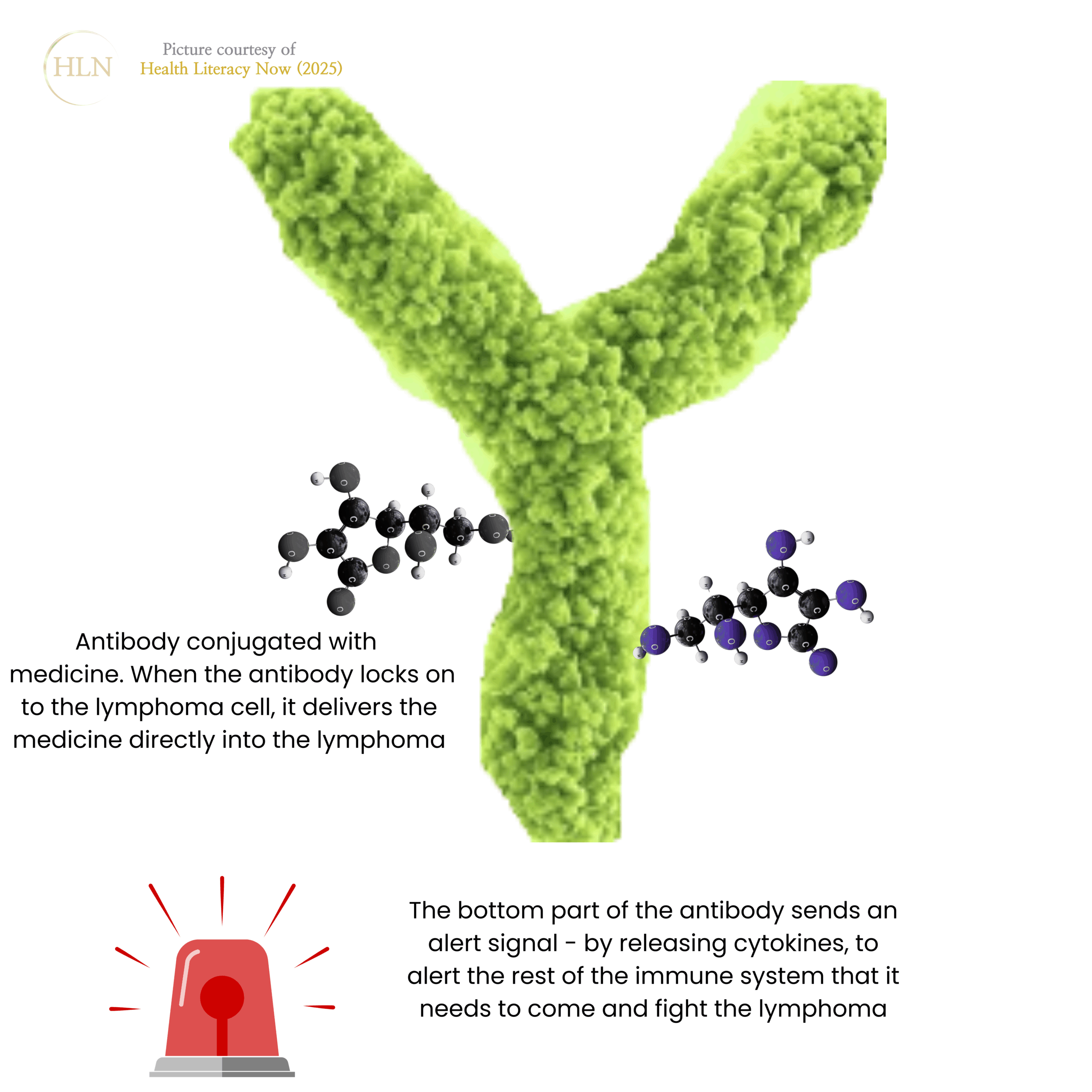
They are antibodies joined in a lab to another medicine such as a toxin, chemotherapy, or a radioactive particle. The antibody acts like a taxi, driving the attached medicine past your healthy cells and straight to the lymphoma cell. The antibody attaches to the antigen on the lymphoma cell (e.g. CD20 or CD19) and then releases the toxin whcih destroys the lymphoma cell.
The antibody also sets off an alert, by releasing chemicals called cytokines that attract other immune cells to come and fight the lymphoma.
This helps deliver the lymphoma fighting medicine straight to the lymphoma while protecting healthy cells.
Examples of Antibody conjugates includes brentuximab vedotin and polatuzumab vedotin.Find out moreAntibody Conjugate
Immunomodulators
Immunomodulators are medicines taken as a tablet. We don’t know exactly how they work, but we think they have several effects against lymphoma. These include:
- directly destroying lymphoma cells
- helping your immune system work more efficiently
- stopping the lymphoma tumour from developing blood vessels. This stops it from getting the oxygen and nutrients it needs to grow
- changing the cytokines (small chemical messengers) that the lymphoma sends to help it grow
- preventing lymphoma growing in your bone marrow.
Chimeric Antigen Receptor T-cell therapy (CAR T-cell therapy)
CAR T-cell therapy is a newer treatment that will only be offered if you have already had at least one other treatment for your DLBCL.
In some cases, you may be able to access CAR T-cell therapy by joining a clinical trial.
CAR T-cell therapy involves an initial procedure similar to a stem cell transplant, where your T-cell lymphocytes are removed from your blood during an apheresis procedure. Like you B-cell lymphocytes, T-cells are part of your immune system and work with your B-cells to protect you from disease and illness.
When the T-cells are removed, they are sent to a laboratory where they are re-engineered. This happens by joining the T-cell to an antigen that helps it recognise the lymphoma more clearly and fight it more effectively.
Chimeric means having parts with different origins so the joining of an antigen to the T-cell makes it chimeric.
Once the T-cells have been re-engineered they will be returned to you to start fighting the lymphoma.
For more information on CAR T-cell therapy please click here.
Stem cell transplants or Bone marrow transplants
A stem cell or bone marrow transplant is done to replace your diseased bone marrow with new stem cells that can grow into new healthy blood cells. Bone marrow transplants are usually only done for children with DLBCL, while stem cell transplants are done for both children adults.
In a bone marrow transplant, stem cells are removed straight from the bone marrow, where as with a stem cell transplant, the stem cells are removed from the blood.
The stem cells may be removed from a donor or collected from you after you’ve had chemotherapy.
If the stem cells come from a donor, it is called an allogeneic stem cell transplant.
If your own stem cells are collected, it is called an autologous stem cell transplant.
Stem cells are collected through a procedure called apheresis. You (or your donor) will be connected up to an apheresis machine and your blood will be removed, the stem cells separated and collected into a bag, and then the rest of your blood is returned to you.
Before the procedure, you will get high-dose chemotherapy or full-body radiotherapy to kill off all your lymphoma cells. However this high dose treatment will also kill off all the cells in your bone marrow. So the collected stem cells will then be returned to you (transplanted). This happens in much the same was as blood transfusion is given, through a drip into your vein.
For more information on Stem Cell transplants, please click here.Stem cells are removed from your blood during an apheresis procedure, with your remaining blood being returned to you.
Supportive care
Supportive care can help patients have fewer side-effects, and recover more quickly from the effects of lymphoma treatment. It can also help manage symptoms of the lymphoma.
Supportive care may include:
- Blood or platelet transfusion to replace cells lost from the lymphoma or its treatment
- Growth factors (like filgrastim or pegfilgrastim) which stimulates the bone marrow to create more white blood cells to prevent infection
- Antinausea medication to help stop you feeling sick
- Anti-infective agents such as antibiotics, antivirals or antifungals to treat or prevent infection
- Pain management
- Social worker to help with all the planning and organisation needed during lymphoma and treatment
- Psychologist or counsellor to help manage the emotional changes from a lymphoma diagnosis or mood changes related to treatment effects
- Other support as needed.
Let your treating team know what extra support you may need. The earlier you let them know, the sooner they can help.
Supportive care can also include palliative care which helps to improve your symptoms and side-effects, as well as end of life care if needed
It is important to know that the Palliative Care team can be called on at any time during your treatment pathway not just at the end of life. They can help control and manage symptoms (like hard to control pain and nausea) you might be experiencing as a result of your disease or its treatment.
If you and your doctor decide to use supportive care or stop curative treatment for your lymphoma, many things can be done to help you to stay as healthy and comfortable as possible for some time.
Radiation treatment
Radiation therapy is not a standard treatment in DLBCL as it is best used for small areas of cancer that are only in 1 or 2 parts of your body. Because of the fast- growing nature of DLBCL it is often larger or in many areas of your body when you are first diagnosed.
In some cases though, it may be useful if there is one small area that has not responded to other treatments, or if the lymphoma is pressing on a vital organ like your airway or spinal cord and you can’t start chemo right away.
It is a targeted treatment that uses high doses of radiation to kill lymphoma cells and shrink tumours. Before having radiation, you will have a planning session. This session is important for the radiation therapists to plan how to target the radiation to the lymphoma, and avoid damaging healthy cells. Radiation therapy usually lasts between 2-4 weeks. During this time, you will need to go to the radiation centre everyday (Monday-Friday) for treatment.
*If you live a long way from the radiation centre and need help with a place to stay during treatment, please talk to your doctor or nurse about what help is available to you. You can also contact the Cancer Council or Leukemia Foundation in your state and see if they can help with somewhere to stay.Radiation can be used to treat early stage lymphoma, or to improve symptoms by shrinking your tumour
What happens when I start treatment?
You will need to start treatment soon after all your test results come back. In some cases, you may start before all of the results are in.
It can be quite overwhelming when you start treatment. You may have many thoughts about how you will cope, how to manage at home, or how sick you might get.
Let your treating team know if you’d like extra support. They can refer you to a social worker or other supportive service to make sure you get the help you need.
What is the first-line treatment for DLBCL?
Treatment for first-line DLBCL is pretty standard. Meaning there are set protocols that have been tested and proven to be effective for most people with DLBCL.
The first time you have treatment you will likely be offered one of the below treatment protocols.
R-CHOP, R-mini-CHOP or SMARTE-R-CHOP
R-CHOP is the most common first-line treatment protocol for people with DLBCL. It includes:
- Rituximab – a monoclonal antibody – attaches to the CD20 marker on the lymphoma cell
- Doxorubicin – a chemotherapy
- Vincristine – a chemotherapy
- Cyclophosphamide – a chemotherapy.
As well as these, you will have medicine to take at home including a corticosteroid called Prednisolone, which are tablets that you take for 5 days. You will also have anti-nausea tablets to stop you feeling sick.
Four days after the chemo, you will need to have a small injection (called pegfilgrastim) under the skin – usually in your tummy. This is to help your white blood cells recover more quickly. This helps to stop you getting an infection.
You will usually have 6 cycles of R-CHOP but may have anywhere between 4 and 8 cycles. Each cycle will either be 14 or 21 days long. You will have the rituximab and chemo on day 1 of each cycle.
R-mini-CHOP and SMARTE-R-CHOP
These 2 treatments use all the same medicines as in R-CHOP, but the doses and timing of the medicine may be different. These are given to older people (over 60years old) or people who are unwell and may not be able to tolerate the full dose of R-CHOP.
DA-R-EPOCH
You may be offered DA-R-EPOCH if you have a high grade DLBCL with genetic variations in the MYC and BCL-2 or BCL-6 genes.
The DA stands for Dose Adjusted. This means your haematologist will change the dose of your chemotherapy each cycle depending on your side-effects.
DA-R-EPOCH includes:
- Rituximab – a monoclonal antibody – attaches to the CD20 marker on the lymphoma cell
- Doxorubicin – a chemo
- Vincristine – a chemo
- Etoposide – a chemo
- Cyclophosphamide- a chemo.
You will need to take corticosteroids – tablets called Prednisolone for 5 days while you are having the chemo. You will also have anti-nausea tablets to stop you feeling sick.
This protocol has 6-8 cycles with each cycle being 21 days (3 weeks). You will have all the chemo and the rituximab in the first 5 days of the cycle.
On day 6, you will start having a small injection called Filgrastim under the skin (usually in your tummy). Filgrastim helps your white cells recover to help prevent infections. You will have this injection every day until your white cells recover.
R-CHOEP
This protocol uses all the same medicines as in DA-R-EPOCH but with regular doses each cycle.
It may be offered to people less than 60 years of age who have stage 3 or 4 DLBCL when first diagnosed.
Each cycle is 14 days (2 weeks), and you will have all the chemo on the first 3 days.
Pola-R-CHP
Pola-R-CHP is a newer treatment protocol that uses similar medicines to other protocols, but also includes a Conjugated Antibody called Polatuzumab Vedotin (Polivy®).
- Rituximab – a monoclonal antibody – attaches to the CD20 marker on the lymphoma cell
- Polatuzumab Vedotin – a Conjugated Antibody
- Doxorubicin – a chemo
- Cyclophosphamide – a chemo
You will likely have 6 cycles including all these medicines and then another 2 cycles with just the rituximab.
As well as the above, you will have medicine to take at home including a corticosteroid called Prednisolone. You will take these for 5 days. You will also have anti-nausea tablets to stop you feeling sick.
Each cycle, on the day after chemo, you will have a small needle in under the skin, usually in your tummy. This medicine is called Filgrastim and helps your white cells recover quickly to avoid infection. You will have this each day until your white cells recover.
Your nurses may teach you, or a trusted friend/family member to give yourself these injections.
♦ Polatuzumab Vedotin is not yet listed on the Pharmaceutical Benefit Scheme (PBS), so you may need to pay for this part of the protocol. Ask your doctor if there are any access schemes that may help lower the cost for you.
Clinical Trials
Clinical trials are how researchers test new treatments, or new combinations of treatments to see if they work better than current treatments.
They may also test if having certain treatments earlier might result in better outcomes.
Talk to your doctor about clinical trials. They can let you know if there are any you are eligible for.
How is relapsed or refractory DLBCL treated?
You may be offered any of the above treatments listed under first-line treatment, or one of the below second-line treatments after a relapse, or if your lymphoma has been refractory to the first-line treatment.
Before deciding on the best options for you, your doctor will consider:
- Your personal situation and goals for treatment
- Any changes to your lymphoma cells during previous treatments, such as new genetic changes
- How the lymphoma has responded to other treatments
- How long you’ve been remission.
Bendamustine, Polatuzumab Vedotin and Rituximab
This treatment protocol may be offered to you if you are:
- unable to have a stem-cell transplant
- waiting to have CAR T-cell therapy.
It includes:
- Rituximab – a Monoclonal Antibody
- Polatuzumab vedotin – an Antibody Conjugate
- Bendamustine – a chemo.
It is given every 21 days (3 weeks), and you will have all these medicine on the first 2 or 3 days of each cycle. You may have up to 6 cycles.
♦ Polatuzumab Vedotin is not yet listed on the Pharmaceutical Benefit Scheme (PBS), so you may need to pay for this part of the protocol. Ask your doctor if there are any access schemes that may help lower the cost
DHAC +/- Rituximab
DHAC may be given with or without rituximab. Your doctor will do tests before you start treatment to see if the lymphoma cells still have the CD20 antigen on them.
Sometimes, after treatment with rituximab in the first-line treatment, lymphoma cells can stop the CD20 from showing.
You will only have rituximab as part of this treatment if the lymphoma still has the CD20 antigen.
DHAC includes 2 types of chemotherapy including cytarabine and carboplatin. You will also have a type of corticosteroid called dexamethasone for 4 days.
This treatment is given every 21 days (3 weeks), and you will have the chemo on the first 2 days of each cycle. You may have 2-6 cycles.
Gemcitabine & Vinorelbine
This protocol includes the 2 chemo’s gemcitabine and vinorelbine. It is given every 21 days (3 weeks) and you will have chemo on the first, and 8th day of each cycle.
On the 9th day you will have Pegfilgrastim, a small injection under the skin (usually in your tummy), to help your white cells recover and help prevent infection.
You may have between 4 and 6 cycles.
R-DHAOx
R-DHAOx is given every 21 days (3 weeks) and you will have treatment on days 1-3 of each cycle. This protocol includes:
- Rituximab – a CD20 targeting monoclonal antibody
- Oxaliplatin – a chemo
- Cytarabine – a chemo.
In addition to these, you will also have another medicine (a corticosteroid) called dexamethasone for 4 days, starting the 1st day of the cycle before you start chemo. You may also be given anti-nausea tablets to take home to stop you feeling sick.
You may have up to 6 cycles of this treatment protocol, or as little as 1 or 2 cycles. Your doctor will assess you regularly to see how the treatment is working, and what side-effects before deciding if you need another cycle.
♦ When having treatment with Oxaliplatin it is important not to touch or eat anything that is cold. It can give you pain, or make it feel like you can’t breathe well. These symptoms are temporary, but unpleasant.
If you are taking something out of the fridge or freezer, use oven mitts.
R-GemOx
You may be offered this treatment if you’re unable to have stem cell transplant, or if you have relapsed after a stem cell transplant.
It includes 8 cycles that is 14 days long (2 weeks). You will have all the treatment on the first day of the cycle. Treatment includes:
- Rituximab – a CD20 targeting monoclonal antibody
- Gemcitabine – a chemo
- Oxaliplatin – a chemo
♦ When having treatment with Oxaliplatin it is important not to touch or eat anything that is cold. It can give you pain, or make it feel like you can’t breathe well. These symptoms are temporary, but unpleasant.
If you are taking something out of the fridge or freezer, use oven mitts.
ICE or R-ICE
ICE includes 3 chemo’s including Etoposide, carboplatin, and ifosphamide. Ifosphamide can cause some inflammation and bleeding in your bladder, so you will also have a medicine called Mesna that protects your bladder, and extra fluids through a cannula or central line, into your veins (IV Fluids) to help flush the chemo out.
In addition to the above, if your lymphoma cells still have the CD20 marker on them, you may have rituximab too (R-ICE).
You may have up to 6 cycles.
ESHAP
ESHAP includes 3 chemo’s – cisplatin, etoposide and cytarabine and a high-dose steroid called Methylprednisolone. You will have the steroids and chemo over the first 5 days of your cycle.
Then, on the 6th day you will have a small injection (called pegfilgrastim) under the skin – usually in your tummy. This is to help your white blood cells recover more quickly. This helps to stop you getting an infection.
Depending on your situation, you may have between 3 and 6 cycles which will 3 or 4 weeks long.
DHAP or R-DHAP
DHAP includes a corticosteroid called dexamethasone, and 2 chemo’s called cytarabine and cisplatin. You may also have a MAB (rituximab) if the lymphoma cells still have the CD20 marker on them. If you have the MAB, the protocol is called R-DHAP.
You may have between 2 and 6 cycles. Each cycle is 21 days (3 week) long and you will have the chemo and MAB on the first 2 days of the cycle. You will have the dexamethasone for the first 4 days of each cycle.
GDP or R-GDP
GDP includes 2 chemos gemcitabine and cisplatin, and a corticosteroid called dexamethasone. If the lymphoma cells still have e CD20 marker on them you will also have rituximab (R-GDP)
Each cycle is 21 days long and you will have the dexamethasone for the first 4 days of each cycle. You will have both chemo’s on the first day of the cycle and then only the gemcitabine on day 8. If you have rituximab, you will have this on day 1 of each cycle.
You may have up to 6 cycles.
Tafasitamab & Lenalidomide
You may be offered this treatment if you are unable to have a stem cell transplant and your lymphoma has maker called CD19 on it. It includes:
- Tafasitamab – a monoclonal antibody that targets the CD19 marker
- Lenalidomide – an immunomodulatory tablet.
There is no set number of cycles for this protocol. You can continue on this treatment for as long as it is effective, and your side-effects are well managed.
Each cycle is 4 weeks (28 days) and the first few cycles are more intensive.
For the 1st cycle you will have:
- Lenalidomide tablets at home for 21 days
- Tafasitamab at the clinic or hospital on days 1, 4, 8, 15 and 22.
Cycle 2 and 3 you will have:
- Lenalidomide tablets at home for 21 days
- Tafasitamab at the clinic or hospital on days 1, 8, 15, 22.
Cycles 4-12 you will have:
- Lenalidomide tablets at home for 21 days
- Tafasitamab at the clinic or hospital on days 1 and 15.
Any further cycles you will have:
- Tafasitamab only on days 1 and 15.
You will need to get to use to having tablets every day for 3 weeks and then remember to stop at the end of the 3rd week. It can be helpful to set an alarm on your phone. There are also some handy apps you can download to help with this. Just check your app store.
Search for “medicine tracker” or “pill reminder” and see if there is one you like.
CAR T-cell Therapy
CAR T-cell therapy is a type of immunotherapy. The name stands for:
- CAR stands for Chimeric Antigen Receptor. A CAR is a special, man-made protein designed to recognise and stick to another receptor called CD19 on your lymphoma cells.
- T-cells are a type of white blood cell in our body that help fight infections and cancer.
It is a complex treatment that happens in stages. including:
- Checking your eligibility
- Collection T-cells from your blood in a procedure called apheresis
- Sending the T-cells to a lab where they have the CAR attached to them
- Getting ready to have the CAR T-cells
- The infusion of CAR T-cells
- Staying in or close to the hospital for up to 2 months
Stem-cell Transplant
Stem-cell transplants are a “rescue” treatment rather than a treatment for DLBCL.
What does that mean you ask?
It means that they are given to rescue or help your bone marrow recover after very high dose chemotherapy. The chemotherapy is the treatment, and the stem-cells help you recover by making new healthy cells.
Usually, we give smaller doses of chemo to make sure you still have enough healthy cells to live, while still destroying the lymphoma over each cycle.
Sometimes, having a higher dose of chemo may give you a better a chance for a cure, or give you a longer-lasting remission. In these cases, your doctor may offer a stem cell transplant.
What are the third-line and later treatment options?
If you have a second relapse, or don’t respond to 2 other treatments, you may be offered any of the above listed treatment protocols, or one of the below treatments.
Before deciding on the best options for you, your doctor will consider:
- Your personal situation and goals for treatment
- Any changes to your lymphoma cells during previous treatments, such as new genetic changes
- How the lymphoma has responded to other treatments
- How long you’ve been remission.
Epcoritamab
Epcoritamab is a bispecific antibody that is given as in injection under the skin – usually in your tummy.
To avoid serious side-effects, on cycle 1 you will start with a lower dose and gradually increase to the regular dose by the end of cycle 1.
There is no set number of cycles, and you can continue to have epcoritamab unless it stops working, or your side-effects become too difficult to manage.
Each cycle is 28 days (4 weeks long).
- Cycles 1-3 You will have the epcoritamab on days 1, 8,15, and 22
- Cycles 4-9 You will have the epcoritamab on days 1 and 15
- Cycle 10 and more You will have epcoritamab on day 1.
Glofitamab & Obinutuzumab
Glofitamab is a bispecific antibody and obinutuzumab is MAB.
You will have up to 12 cycles every 21 days (3 weeks), and you will only have the obinutuzumab in the 1st cycle.
- Cycle 1 – Obinutuzumab day 1, Glofitamab days 8 and 15
- Cycles 2-12 – Glofitamab only on day 1.
Clinical trials
Many clinical trials are looking at how to improve treatment for people need third, or later line treatments.
We recommend you talk to your doctor about clinical trials, and if there are any you may be eligible for.
Learn more via the eviQ site
If you know what treatment you are having, the eviQ website is a great resource. Visit eviQ
Can I join a DLBCL clinical trial?
It is recommended that anytime you need to start new treatments you ask your doctor about clinical trials you may be eligible for.
Clinical trials are important to find new medicines, or combinations of medicines to improve treatment of DLBCL in the future.
They can also offer you a chance to try a new medicine, combination of medicines or other treatments that you would not be able to get outside of the trial. If you are interested in participating in a clinical trial, ask your doctor what clinical trials you are eligible for.
There are many treatments and new treatment combinations that are currently being tested in clinical trials around the world for patients with both newly diagnosed and relapsed DLBCL.
For medicine to be routinely available in Australia it needs to be registered with the Therapeutics Goods Administration (TGA). For it to be public funded, making them more affordable, they need to listed on the Pharmaceutical Benefits Scheme (PBS).
These processes can take years, and not all medicines registered with the TGA will be listed on the PBS. This means, that even when they are available, some treatments may be a lot more expensive than others.
However, there are some options that may help you access some of these medicines if your haematologist believes they offer a better chance at cure, remission, or disease management. Watch the video to see how options work.
This information gives an overview of common treatments currently available and funded under the PBS as of October 2025. Your haematologist may recommend something other than what is listed here. Always ask your haematologist to explain all your options, and any costs of treatments.