
On this page
DLBCL at a glance
- DLBCL is a type of aggressive blood cancer affecting your B-cell lymphocytes, which fight infection and disease.
- DLBCL is the most common subtype of lymphoma, however there are different types of DLBCL.
- Many people can be cured, or go into remission from DLBCL, even when diagnosed at stage 4.
The Australian Institute of Health and Welfare (AIHW) reports that 2,146 people were diagnosed with DLBCL in Australia during 2021, a 22% increase on 2011 diagnoses, and DLBCL is the most common lymphoma subtype across all ages and genders.
What is diffuse large B‑cell lymphoma (DLBCL)?
Diffuse Large B Cell lymphoma (DLBCL) is a group of blood cancers that changes certain blood cells in your body called B-cell lymphocytes (B-cells).
It usually starts when B-cells in your lymph nodes (sometimes called glands) and your lymphatic system become cancerous.
DLBCL develops when some of your B-cells become cancerous and are spread out (diffuse) rather than grouped closely together. They grow uncontrollably, are abnormal, and do not die when they should.
Although DLBCL is usually a fast growing (aggressive) lymphoma, many people with DLBCL can be cured with treatment, even if you are diagnosed with an advanced stage.
What are B‑cells and how does DLBCL develop?
To understand DLBCL you need to know a bit about your B-Cell lymphocytes.
B-Cell lymphocytes:
- Are a type of white blood cell
- Fight infection and diseases to keep you healthy.
- Remember infections you had in the past, so if you get the same infection again, your body’s immune system can fight it more effectively and quickly.
- Are made in your bone marrow (the spongy part in the middle of your bones), but usually live in your spleen and your lymph nodes. Some live in your thymus and blood too.
- Can travel through your lymphatic system, to any part of your body to fight infection or disease.
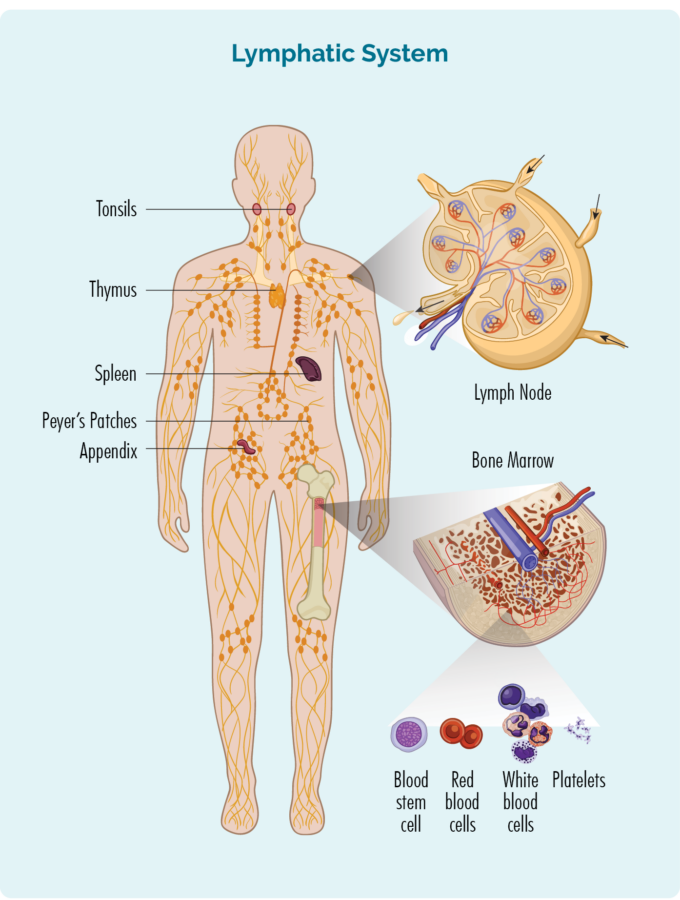
Your lymphatic system is part of your immune system and keeps you healthy by fighting germs. It includes your lymph nodes, lymphatic vessels and organs such as your spleen, thymus and others. Your B-cell lymphocytes live mostly in your lymphatic system.
Lymphoma develops when some of your B-cell lymphocytes (B-cells) become cancerous. They grow uncontrollably, are abnormal, and do not die when they should.
When you have lymphoma your cancerous B-cells:
- Will not work as effectively to fight infections and disease.
- Can become larger than they should and can look different to your healthy B-cells.
- Can cause lymphoma to develop and grow in any part of your body.
Some lymphomas grow very quickly, which means the cancerous B-cells are multiplying (making new copies of themselves). Other cancerous B-cells may live longer than they should. B-cells (and many other cells) are designed to live for a purpose. Once they have achieved that purpose, they naturally die to make room for new stronger healthy B-cells.
In some cases, lymphoma develops when the cancerous B-cells just keep living even when they have no purpose. They then take up too much room which can stop your body making new healthy cells.
What causes DLBCL?
We don’t know what causes DLBCL, but different risk factors are thought to increase your risk of developing it. Some, risk factors for DLBCL are thought to include the following if you:
- Have a condition affecting your immune system such as human immunodeficiency virus (HIV).
- Are taking medicines that suppress your immune system, such as those taken after an organ transplantation.
- Have a family member with lymphoma.
- Have hepatitis C – a virus affecting your liver.
- Were overweight as a child.
*It is important to note, not all people who have these risk factors will develop DLBCL, and some people with none of those risk factors can develop DLBCL.
Video: what is DLBCL?
What are the subtypes of DLBCL?
There are many subtypes of DLBCL. The two main subtypes are named based on the specific cell your lymphoma began growing from. The most common is “Activated B-cell (ABC)”, with about half of all patients with DLBCL having this subtype. The other main subtype of DLBCL is “Germinal Cell B-cell (GCB)”, with about 3 in every 10 people with DLBCL having this subtype.
Your doctor can tell whether you have the GCB or ABC subtype by looking at your lymphoma cells in pathology. The two subtypes look different by having different proteins on the surface of the cells, and different genetic mutations.
Once your doctor and treating team know if you have GCB or ABC, they may do additional cytogenetic tests on your lymphoma cells. These tests check for other genetic changes in your chromosomes and genes (called rearrangements). You can read more under Understanding your lymphoma genetics.
What is the germinal centre?
The germinal centre is a special area inside your lymph nodes where certain B-cells grow and mature after they’ve been exposed to an infection or vaccine. It is like a training ground where B-cells learn to recognise germs better and make strong antibodies to help protect your body from disease.
- Germinal centre B-cell (GCB) DLBCL starts from B-cells that are still maturing in the lymph node’s germinal centre.
- Activated B-cell (ABC) DLBCL starts from B-cells that have already left the germinal centre and are further along in development, which often makes it harder to treat.
DLBCL can also be called nodal or extra-nodal. Nodal means that it started in your lymph nodes, whereas extra-nodal means it started outside of your lymphatic system. Some extra-nodal places that DLBCL can start include your skin, breasts, testicles, liver, lung, bone, brain, stomach or bowels.
Other subtypes of DLBCL
Treatment for GCB and ABC subtypes of DLBCL can differ because ABC-DLBCL may need more aggressive treatment. PCNSL also needs different treatment that will cross over the blood brain barrier (BBB) which is a filter that protects the brain and spinal cord. All other subtypes of DLBCL are treated in the same way.
Primary mediastinal B-cell lymphoma (PMBCL)
Primary mediastinal B-cell lymphoma (PMBCL) is a rare aggressive (fast-growing) type of non-Hodgkin Lymphoma. It used to be classified as a sub-type of DLBCL, but has now been reclassified by the World Health Organisation as a subtype on its own.
For more information on PMBCL, please see our Primary Mediastinal B – cell lymphoma (PMBCL) webpage here, or our factsheet here.
T-cell/Histiocyte rich B-cell lymphoma (T/HRBCL)
T-cell/histiocyte rich B-cell lymphoma (T/HRBCL) is a rare subtype of DLBCL that can be very difficult for your doctor to diagnose. It is difficult to diagnose because it looks a lot like two other subtypes of lymphoma. For this reason, some people with T/HRBCL can get a wrong diagnosis of Hodgkin’s lymphoma or peripheral T-cell lymphoma, before getting the right diagnosis. You will need some special tests to diagnose T/HRBCL called immunohistochemistry tests. This is a special test done on your biopsies so your doctor can learn more about your lymphoma.
T-cells are another type of lymphocyte cell that helps your immune system remember infections you’ve had in the past. They help to keep your immune system in check so it doesn’t work too hard, and also supports other cells of your immune system to work more effectively. Histiocytes are also a type or immune cell called a phagocyte. Phagocytes help to protect you from infection and disease because they recognise the bad cells and eat them.
If you have T/HRBCL – you have too many T-cells and histiocytes (which is why it’s called “rich” – T/HR) while also having cancerous B-cell lymphocytes (BCL).
Standard treatment for T/HRBCL is the same as most other subtypes of diffuse large B-cell lymphoma (DLBCL), discussed later on this webpage.
EBV-positive DLBCL not otherwise specified (NOS)
EBV-positive DLBCL not otherwise specified is a subtype of DLBCL that can occur in young people, but most commonly affects people over 50 years of age. It occurs in some people who have had a virus called Epstein-Barr virus (EBV), which affects B-cells. EBV causes glandular fever (also called “mono” or the kissing disease). However, only a very small number of people who have had EBV go on to develop EBV-positive DLBCL. Unfortunately we currently have no way of knowing who will develop this lymphoma after infection with EBV.
Symptoms will depend on where your lymphoma is growing. It usually starts in your lymph nodes (called nodal lymphoma) which can cause a new lump to come up. This is usually in your neck, armpit, groin or tummy, but can be anywhere in your body.
Other places it can grow and the symptoms associated with it are similar to those listed above in table one.
Standard treatment for intravascular large B-cell lymphoma is the same as most other subtypes of diffuse large B-cell lymphoma (DLBCL), discussed later on this webpage.
ALK-positive large B-cell lymphoma
ALK-positive large B-cell lymphoma is a very rare subtype of DLBCL. It can affect people of any age and is more common in men. The lymphoma cells have a gene mutation that makes a protein on the surface of their B-Lymphocyte cells called ‘anaplastic large-cell kinase’ (ALK).
Most subtypes of DLBCL have a protein on the lymphoma cells called CD20. However, ALK positive large B-cell lymphomas do not usually have the CD20 protein. For this reason, treatment will be slightly different from other DLBCL subtypes. Although most of the medications will be the same, if you have this subtype, you will not receive a monoclonal antibody medicine called rituximab. Rituximab only works when CD20 is found on the lymphoma cells. So, if you’re wondering why you may not be getting the extra medicines other patients are getting….this may be the reason.
ALK-positive large B-cell lymphoma usually starts in your lymph nodes, so a common symptom you might experience is swollen lymph nodes.
However, it can also start in areas outside of your lymphatic system, including your:
- tongue
- nasopharynx (the area at the back of your nose and mouth)
- ovaries
- liver
- breasts
- bones
- stomach
- brain or epidural space (an area surrounding your spine)
Your symptoms will relate to where the lymphoma is growing.
Intravascular large B-cell lymphoma
Intravascular large B-cell lymphoma is a rare form of an *extra-nodal DLBCL. It mostly affects older adults between 50-70 years of age. This subtype occurs equally in both men and women. The lymphoma cells are found within the inside lining of your small blood vessels. These small blood vessels are called capillaries.
Intravascular large B-cell lymphoma does not usually cause enlarged lymph nodes. It may affect small blood vessels in your skin or your brain. You may have central nervous system (CNS) symptoms. Your central nervous system includes your brain and spinal cord, so the symptoms you experience may include:
- confusion
- seizures
- dizziness
- weakness
Other symptoms you may experience specific to your subtype include:
- reddened patches or lumps on your skin
- an enlarged liver and/or spleen
These symptoms are in addition to the general lymphoma symptoms listed above.
Standard treatment for intravascular large B-cell lymphoma is the same as most other subtypes of diffuse large B-cell lymphoma (DLBCL), discussed later on this webpage.
*Extra-nodal means your lymphoma developed outside of your lymph nodes.
Primary central nervous system lymphoma (PCNSL)
Primary Central Nervous System Lymphoma (PCNSL) is a rare subtype of DLBCL that is considered aggressive because it grows quickly. It is more common in people aged between 50 and 60 years of age, but can occur at any age.
If you have PCNSL your lymphoma likely started in your central nervous system, which includes your brain and spinal cord.
In more than 9 out of 10 people that have PCNSL the lymphoma develops in the brain, spinal cord, eye or leptomeninges (the inner two membranes surrounding the brain and spinal cord).
The most common site is in the brain.
If your lymphoma has started in other parts of your body first then at some stage has spread to the brain or spinal cord, it is referred to as ‘secondary’ CNS lymphoma (SCNSL).
Treatment and management of PCNSL is different from other subtypes of DLBCL as the standard treatments cannot reach your brain and spinal cord. You can read more about the treatments for PCNSL later in the webpage under the heading Treatments.Your central nervous system involves you brain, spinal cord, your eyes and their protective membranes. It is protected by cerebral spinal fluid (CSF)
Cutaneous (skin) B-cell lymphoma (CBCL)
Cutaneous (skin) B-cell lymphoma is a rare subtype of DLBCL that develops from the B-cells in your skin. Less than 1 out of 100 people with NHL will be diagnosed with this subtype.
For your doctor to diagnose you with this subtype, the lymphoma needs to be only affecting your skin.
Because this lymphoma starts in your skin, the main symptoms you may notice include are lumps, patches or a rash anywhere on your skin.
As cutaneous B-cell lymphomas are managed differently to other DLBCL subtypes, we have dedicated a different webpage to these subtypes.
Please note that if you have been diagnosed with another subtype of DLBCL and it has spread to your skin, you should continue to look at the information on that first subtype. If the lymphoma has spread to your skin after starting somewhere else, it is considered secondary cutaneous lymphoma. Primary and secondary cutaneous lymphomas are managed differently.
Additionally, if you have cutaneous T-cell lymphoma, this is different again.